Background Information
Sound travels when particles vibrate and pass energy from one particle to the next. How fast sound travels depends on how quickly vibrations are transferred, not just how close particles are.
In different states of matter:
In gases, particles are far apart, so vibrations are passed slowly
In liquids, particles are closer together, so vibrations move faster
In solids, particles are tightly packed and strongly connected, allowing vibrations to move fastest
Within liquid water, temperature changes affect particle motion in a different way. As water gets warmer, particles move faster and transfer vibrations more quickly, even though they may be slightly farther apart. The increased motion helps sound waves move through the water more efficiently.
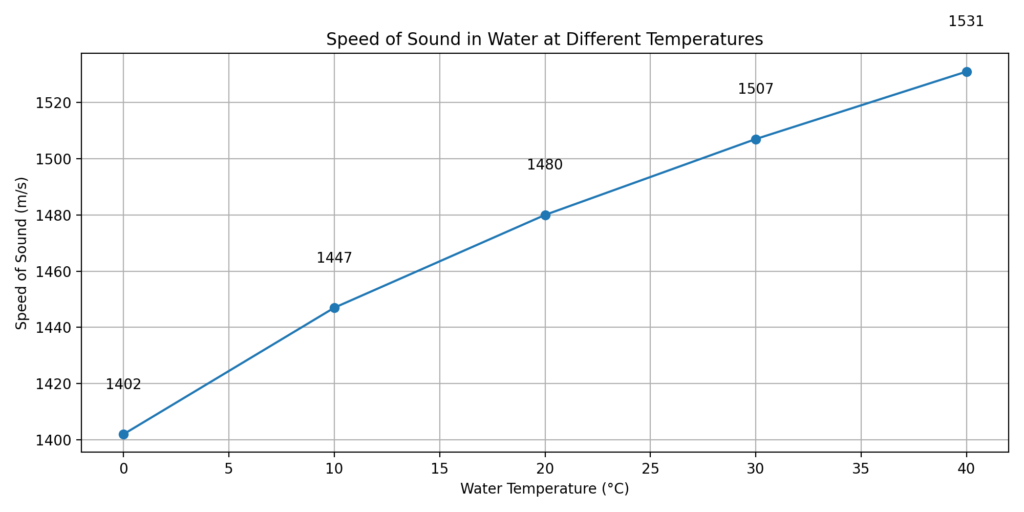
This graph shows how particle motion in liquid water affects the speed of sound as temperature increases.
CER Question
How does the speed of sound in liquid water change as temperature increases?
Claim
Make a claim describing how the speed of sound in water changes as temperature increases.
Evidence
Use specific values from the graph to support your claim. Include at least two temperatures and the corresponding speeds of sound (m/s).
Reasoning
Explain why this pattern occurs. In your explanation, describe how particle motion changes as temperature increases this affects the speed of sound.
Additional Questions
About how fast does sound travel in water at 0°C, and how does this compare to the speed at 40°C?
What overall pattern do you notice in the graph as temperature increases?
Between which two temperature measurements shown does the speed of sound increase the most?
How might this change in sound speed affect animals that rely on sound in water, such as whales or dolphins?
Why do you think scientists study sound speed in water at different temperatures instead of just one temperature?