Background Information
Sound travels through materials when particles vibrate and pass energy from one particle to the next. Sound must travel through a material, and different materials have particles arranged in different ways.
In gases, such as air, particles are far apart. In liquids, such as water, particles are closer together. In solids, such as wood, glass, and metal, particles are very closely packed and are usually fixed in place.
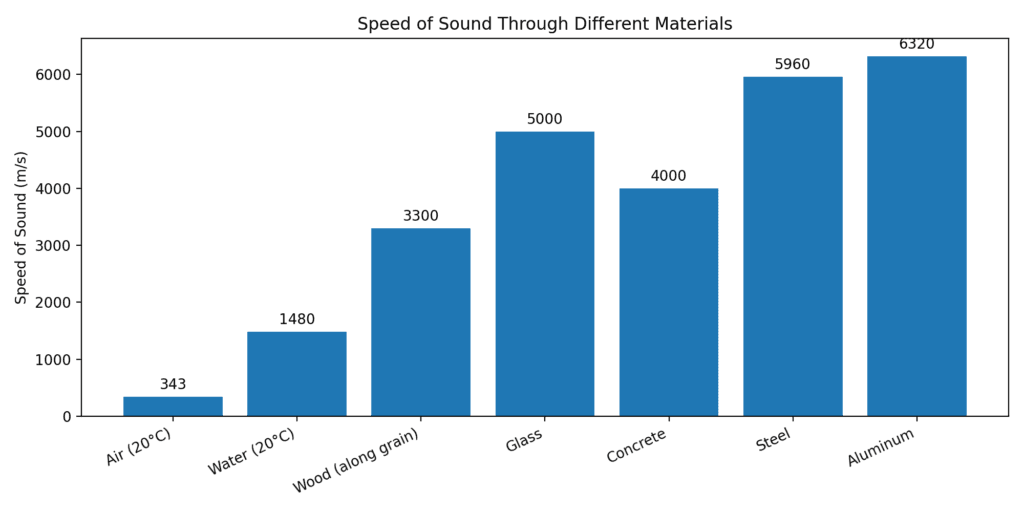
This graph compares the speed of sound through several common materials, measured in meters per second (m/s). By comparing materials with different particle spacing, the graph can be used to explore how particle arrangement affects the speed of sound.
CER Question
How does the speed of sound change as it travels through materials with different particle spacing?
Claim
Make a claim describing which type of material allows sound to travel the slowest and which type allows sound to travel the fastest.
Evidence
Use specific data from the graph to support your claim.
Include:
Names of materials
Speed values with units (m/s)
Reasoning
Explain why sound travels at different speeds in different materials.
In your explanation:
Describe how particle spacing affects sound waves
Explain why materials with closely packed particles allow sound to travel faster
Connect particle movement to the pattern shown in the graph
Additional Questions
Which material on the graph allows sound to travel the slowest, and about how fast is it?
Which material allows sound to travel the fastest, and about how fast is it?
How does the speed of sound in water compare to its speed in air? Use data from the graph.
What pattern do you notice when comparing gases, liquids, and solids?
Why might sound travel faster through a solid wall than through the air?