Background Information
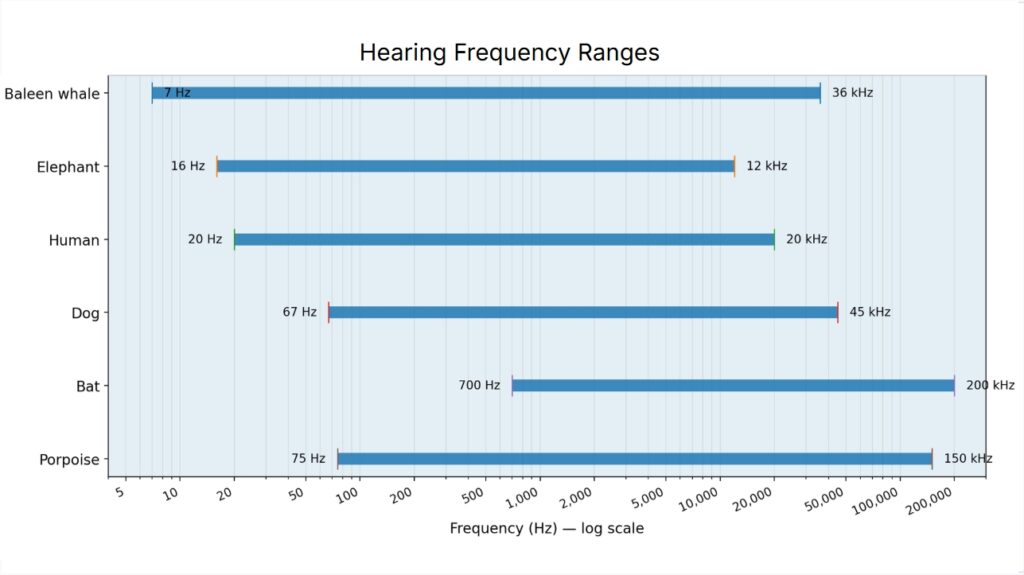
Different animals can hear different ranges of sound frequencies. Hearing is an adaptation, which means it is a trait that helps an animal survive in its environment.
Why might high-frequency hearing be helpful?
Some animals, such as bats and porpoises, use a process called echolocation. Echolocation happens when an animal makes sounds and listens to the echoes that bounce back to locate objects. High-frequency sounds work best for echolocation because they have shorter wavelengths, which makes it easier to detect small objects and fine details, such as insects or fish.
Why might low-frequency hearing be helpful?
Low-frequency sounds can travel farther distances and bend around obstacles more easily than high-frequency sounds. This helps animals like baleen whales communicate across long distances in the ocean and helps animals like elephants stay in contact over wide areas on land. Low-frequency sounds can also help animals detect large events in their environment, such as distant movement or storms.
How animals use sound (adaptations):
Animals use sound for:
Communication
Finding food
Avoiding predators
Navigation, including echolocation
CER Question
Which animals on the graph are adapted to hear the highest-frequency sounds, and which animals can hear the lowest-frequency sounds?
Claim
Make a claim naming the animal or animals that hear the highest frequencies and the animal or animals that hear the lowest frequencies.
Evidence
Use specific data from the graph to support your claim.
Include frequency values with units (Hz or kHz).
Reasoning
Explain why these hearing ranges make sense as adaptations for the animals.
Connect the hearing range to how the animals survive in their environment, such as communication, finding food, or navigation.
Additional Questions
Which animals on the graph can hear sounds humans cannot hear? Explain how you know using the graph.
Which animal would be best at hearing very high-pitched sounds? Which would be best at hearing very low-pitched sounds?
Compare the hearing ranges of humans and dogs. What is one similarity and one difference you notice?
Why might animals that live underwater benefit from having different hearing ranges than animals that live on land?
Look at the length of each bar. What does a longer bar tell you about an animal’s hearing compared to a shorter bar?
Embed This Graph of the Week
Copy and paste this code into your LMS or website (Canvas, Google Sites, etc.).